CppCon continues to grow as a conference that reflects the full breadth of modern C++ practice. One of the ways we support that breadth is through dedicated tracks. These tracks highlight areas of sustained interest in the community and create space for deeper, more focused conversations.
Tracks are a distinct aspect of CppCon. They allow speakers to target specific audiences and give attendees a way to engage more deeply with topics that matter to them. Just as importantly, they make room for material that might not otherwise surface in a general program, strengthening the overall conference.
For 2026, we are continuing with all of last year’s tracks:
- Back to Basics
- Software Design
- Tooling & Ecosystem
- Embedded
- Robotics & AI
- Scientific Computing
- Game Development
- Business & Career
Below is a closer look at each track and the role it plays within the program.
Back to Basics
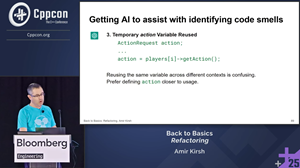 The Back to Basics track focuses on teaching and reinforcing the fundamentals of C++. Talks in this track emphasize clear explanations of core language and library features, presented from first principles so that attendees can build a strong mental model.
These sessions are technical, but intentionally structured to be approachable. They are valuable for developers at all levels, whether learning a topic for the first time or revisiting it with greater depth and precision.
Example talks from CppCon 2025:
- Back to Basics: Master C++ Friendship by Mateusz Pusz
- Back to Basics: How to Refactor C++ Code by Amir Kirsh
Software Design
The Software Design track centers on how we structure and evolve software systems. It focuses on managing complexity through abstraction, reducing coupling, and building systems that are maintainable and adaptable over time.
Topics often include architectural patterns, design techniques across paradigms, and lessons learned from real-world systems. This track reflects the idea that
design decisions often have a greater long-term impact than low-level implementation details.
Example talks from CppCon 2025:
- API Structure and Technique: Learnings from C++ Code Review by Ben Deane
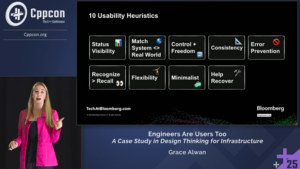
- Engineers Are Users Too: A Case Study in Design Thinking for Infrastructure by Grace Alwan
Tooling & Ecosystem
 The Tooling & Ecosystem track explores both the tools used to build C++ software and the broader ecosystem that supports modern development. This includes compilers, build systems, debuggers, static analysis, IDEs, and libraries, as well as package management and integration with other platforms.
Alongside deep dives into specific tools, this track also covers how C++ fits into larger software environments. Topics may include dependency management, interoperability, and developer workflows, with an emphasis on practical experience and improving how C++ is developed and delivered in real-world settings.
Example talks from CppCon 2025:
- Debugging C++ Coroutines in GDB by Zartaj Majeed
- What’s New in Visual Studio for C++ Developers in 2025 by Augustin Popa & David Li
- Is Your C++ Code Leaking Memory? Discover the Power of Ownership-Aware Profiling by Alecto Irene Perez
Embedded
 The Embedded track showcases how C++ is used in constrained and hardware-adjacent environments. Sessions explore performance, memory efficiency, determinism, and reliability—key concerns in systems where resources are limited and correctness is paramount. The track also highlights tools and techniques for developing safety-critical applications, including machine controllers and medical devices.
Attendees can expect to learn practical approaches for writing efficient low-level code while applying modern C++ abstractions thoughtfully and effectively.
Example talks from CppCon 2025:
- Building Robust Inter-Process Queues in C++ by Jody Hagins
- Wait is it POSIX? Investigating Different OS and Library Implementations for Networking by Katherine Rocha
Robotics & AI
 The Robotics & AI track focuses on real-world systems that combine C++ with robotics, autonomy, and machine learning. Unlike academic venues, the emphasis is on practitioner experience, applied techniques, and lessons learned in production systems.
Topics may include motion planning, perception systems, simulation, and performance-critical AI infrastructure, all grounded in practical use of C++.
Example talks from CppCon 2025:
- Can Modern C++ SPEED UP Your Bundle Adjustment Pipeline? by Vishnu Sudheer Menon
- Agentic C++ Debugging Live! – Without a Safety Net by Daisy Hollman & Mark Williamson
- Best Practices for AI Tool Use in C++ by Jason Turner
Scientific Computing
 The Scientific Computing track covers high-performance and numerically intensive applications. Talks often address parallelism, numerical methods, large-scale data processing, and efficient use of modern hardware.
This is where C++ is applied to demanding computational workloads, from simulation to optimization and beyond.
Example talks from CppCon 2025:
- Optimize Automatic Differentiation Performance in C++ by Steve Bronder
- Lazy and Fast: Ranges Meet Parallelism in C++ by Daniel Anderson
Game Development
The Game Development track explores how C++ is used to build high-performance, real-time interactive systems. Many of the techniques discussed in this track have broader applicability to any system where responsiveness and performance are critical.
Game development is one of the largest users of C++. It faces some tough engineering challenges that only C++ can solve, such as delivering a rendered frame in 16 milliseconds, synchronizing state across the internet for multiplayer games, accommodating the ever-changing brief of the game designer, and so on.
 We all know that GameDev engineering does things a little differently, and this is the place to share the knowledge that the whole C++ community can benefit from. Topics of interest include:
- Patterns in game development
- Building engines
- Build systems
- Profiling and optimizing
- Accommodating hardware constraints
- Interacting with the C++ Standard
- Debugging interactive programs
- GPU programming
- Case studies and post-mortems
- …
- Oh yes, and AI
Example talks from previous CppCon years:
- Can C++ Data Oriented Design Be ONE MILLION Times Faster? by Andrew Drakeford
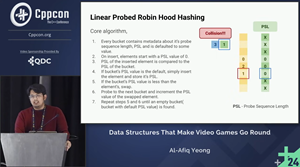
- C++ Data Structures That Make Video Games Go Round by Al-Afiq Yeong
This is a great opportunity to network with your peers from the international GameDev engineering community. If you have done anything at all interesting, we all want to hear about it.
Business & Career
 The Business & Career track focuses on the professional side of working with C++. It includes topics such as team organization, leadership, career growth, and the role of C++ within industry.
This track broadens the scope of the conference by addressing how technical work connects to business outcomes and personal development.
Example talks from CppCon 2025:
- Mastering the Code Review Process by Peter Muldoon
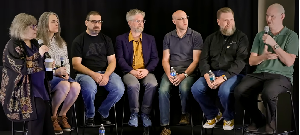
- Building a C++ Career Off-Road by Sherry Sontag and panel
Submit to CppCon 2026
If you are considering submitting a talk, we encourage you to think about how your proposal might fit into one or more of these tracks. When submitting, you can indicate which tracks are relevant to your talk.
👉 Submit your proposal here: https://cppcon.org/submissions
Tracks help us surface ideas, experiences, and communities that deserve focused attention. We are excited for what you bring to CppCon 2026!